Genetic competition in tree breeding trials: repeated measures
Saulo F. S. Chaves
2025-01-21
Source:vignettes/multi_age.Rmd
multi_age.RmdIntroduction
This vignette describes the workflow for considering genetic
competition in a repeated measures context, in tree breeding trials,
using gencomp. More details about the theory underlying
gencomp can be found at Filipe
Manoel Ferreira et al. (2024) and Chaves
et al. (2025).
To begin, load gencomp using the code below. Note that
gencomp has a strong dependency on asreml,
which is a package that is not freely available. Thus, it is vital that
asreml is installed. The ggplot2 (Wickham 2016) library will also be loaded for
customizing the plots. This is not mandatory.
Data description
gencomp has two available datasets. The representative
for tree breeding is called euca, whose phenotypes were
simulated using parameters from a real data of an intermediate-stage
clonal eucalyptus trial. It has the mean annual increment values
(m3 ha-1 year-1, column
MAI) of a total of 100 clones (“C001” to “C100” in
clone column) laid out in a randomized complete block
design with 13 replicates (“B01” to “B13” in block column).
The experimental unit is the same as the observation unit, i.e., there
is a single plant per plot. The plants are spaced by 2 and 3 meters in
the row and column directions, respectively; and the position of each
tree in the field is found in columns row and col. Phenotypes of two
ages are available (“3y” and “6y” in age column). This
trial was not organized into contiguous blocks: the first six blocks
were situated in one area, while the other seven were in another. The
dataset includes a column labelled area, distinguishing
between these areas. We will use a single age to illustrate
gencomp’s pipeline:
| age | area | block | clone | tree | dist_row | dist_col | row | col | MAI |
|---|---|---|---|---|---|---|---|---|---|
| 3y | A1 | B02 | C015 | 104 | 2 | 3 | 40 | 4 | NA |
| 3y | A1 | B02 | C003 | 105 | 2 | 3 | 40 | 5 | 6.02 |
| 3y | A1 | B02 | C048 | 106 | 2 | 3 | 40 | 6 | 32.13 |
| 3y | A1 | B02 | C034 | 107 | 2 | 3 | 40 | 7 | 27.46 |
| 3y | A1 | B02 | C008 | 108 | 2 | 3 | 40 | 8 | 28.64 |
| 3y | A1 | B02 | C028 | 109 | 2 | 3 | 40 | 9 | 56.42 |
Building the competition matrix
The competition matrix (or incidence matrix of competition effects),
henceforth depicted as
is indispensable for the analysis. In the case of tree breeding, due to
the large area occupied by a single tree and large spacing between
trees, the standard procedure is to compute the directional competition
intensity factors for each direction by filling the positions
corresponding to the candidates neighbouring a focal tree in the
respective row of
.
Currently, gencomp has three options for computing the
directional competition intensity factors:
-
Muir (2005) (
MU) The competition intensity factors are the inverse of the distance between the focal individual and its neighbors in the diagonal, row and column directions:
where , and are the directional competition intensity factors for a given plot (i.e., a given row of ) in the row, column and diagonal directions, respectively; and are the distance between the focal individual and its neighbors in the row and column directions, respectively.
-
Cappa and Cantet (2008)
(
CC) the distance and the number of neighbours in each direction are considered. This method assumes that the distance between the focal individual and its neighbours in the row is the same as the distance between the focal individual and its neighbours in the column:
where , and are the number of neighbors in the row, column and diagonal directions, respectively
-
Costa e Silva and Kerr (2013)
(
SK) considers the number of neighbors, the distance between the focal individual and its neighbors and the difference between distances in the row and column directions:
where .
Once the direction competition intensity factors are estimated, the
mean competition intensity factor
(,
or CIF, in the function’s output) is obtained as
follows:
In the multi-age model,
,
i.e., a unique competition matrix must be built for each age level
.
To build the
,
gencomp has the function prepfor. Here is how
to use it employing the example dataset:
comp_mat = prepfor(
  data = euca,
  gen = 'clone',
  area = 'area',
  plt = 'tree',
  age = 'age',
  row = 'row',
  col = 'col',
  dist.col = 3,
  dist.row = 2,
  trait = 'MAI',
  method = 'SK',
  n.dec = 3,
  verbose = TRUE,
  effs = c("block")
)
data is the working dataset. gen,
row, col, and trait are the
column names in the dataset that contain the information of genotypes,
row, column, and trait, respectively. dist_row and
dist_col are the distances between rows and columns,
respectively. method refers to the method to be used to
compute the competition intensity: it should be "MU",
"CC" or "SK" (as detailed above).
area and age are NULL by default,
but if you have non-contiguous blocks (as we have in our example) and
multi-age (repeated measures) data, you can add the name of the columns
that contain this information in the data frame. n.dec is
the number of decimal digits to show in
.
The plt argument is optional (defaulting to
NULL) and allows users to specify the name of the column
containing plot information. This helps ensure that the functions follow
the same order as the data collection in the field. If plt
is not provided, the function will automatically generate a column to
differentiate the plots, ordering the dataset by row and column. The
effs argument accepts a string vector with the names of
columns representing other effects to be considered in the model fitting
step. For instance, the effect of block (block). Note that
the effect due to age (column age) will be automatically
converted to factor. Finally, verbose controls whether a
progress bar is printed in the console or not.
The prepfor function generates a list of class
comprepfor. This list has the following elements:
- A data frame with the inputted data and merged:
comp_mat$data[c(1:5, (nrow(comp_mat$data) - 5):nrow(comp_mat$data)),
c(1:5, (ncol(comp_mat$data)-4):ncol(comp_mat$data))]| C001 | C002 | C003 | C004 | C005 | dist_row | dist_col | row | col | MAI |
|---|---|---|---|---|---|---|---|---|---|
| 0 | 0 | 0 | 0 | 0.48 | 2 | 3 | 29 | 4 | 24.22 |
| 0 | 0 | 0 | 0 | 0.40 | 2 | 3 | 29 | 5 | 28.05 |
| 0 | 0 | 0 | 0 | 0.32 | 2 | 3 | 29 | 6 | 2.11 |
| 0 | 0 | 0 | 0 | 0.00 | 2 | 3 | 29 | 7 | 24.31 |
| 0 | 0 | 0 | 0 | 0.00 | 2 | 3 | 29 | 8 | 58.35 |
| 0 | 0 | 0 | 0 | 0.00 | 2 | 3 | 14 | 42 | 5.99 |
| 0 | 0 | 0 | 0 | 0.00 | 2 | 3 | 14 | 43 | 3.16 |
| 0 | 0 | 0 | 0 | 0.00 | 2 | 3 | 14 | 44 | 10.85 |
| 0 | 0 | 0 | 0 | 0.00 | 2 | 3 | 14 | 45 | 37.41 |
| 0 | 0 | 0 | 0 | 0.00 | 2 | 3 | 14 | 46 | NA |
| 0 | 0 | 0 | 0 | 0.00 | 2 | 3 | 14 | 47 | 59.87 |
-
lists, with each lists containing the following information
particularized by age (taking the
Age_3yas example):
2.1. A data frame containing the phenotypic records of each focal tree and its neighbors:
head(comp_mat$Age_3y$neigh_check)
#>    gen row col   y_focal    y_row n_row     y_col n_col    y_diag n_diag
#> 1 C070  29   4 24.221412 28.05104     1       NaN     0  6.466753      1
#> 2 C071  29   5 28.051038 13.16738     2  6.466753     1 19.680433      1
#> 3 C090  29   6  2.113346 26.18276     2 19.680433     1 18.131841      2
#> 4 C096  29   7 24.314490 30.23192     2 29.796930     1 27.012877      2
#> 5 C083  29   8 58.350503 14.37096     2 34.345321     1 29.796930      1
#> 6 C060  29   9  4.427432 39.01547     2       NaN     0 34.345321      1
#>    y_neigh
#> 1 17.25890
#> 2 13.12049
#> 3 21.66193
#> 4 28.85731
#> 5 23.22104
#> 6 37.45875| gen | row | col | y_focal | y_row | n_row | y_col | n_col | y_diag | n_diag | y_neigh |
|---|---|---|---|---|---|---|---|---|---|---|
| C070 | 29 | 4 | 24.22 | 28.05 | 1 | NaN | 0 | 6.47 | 1 | 17.26 |
| C071 | 29 | 5 | 28.05 | 13.17 | 2 | 6.47 | 1 | 19.68 | 1 | 13.12 |
| C090 | 29 | 6 | 2.11 | 26.18 | 2 | 19.68 | 1 | 18.13 | 2 | 21.66 |
| C096 | 29 | 7 | 24.31 | 30.23 | 2 | 29.80 | 1 | 27.01 | 2 | 28.86 |
| C083 | 29 | 8 | 58.35 | 14.37 | 2 | 34.35 | 1 | 29.80 | 1 | 23.22 |
| C060 | 29 | 9 | 4.43 | 39.02 | 2 | NaN | 0 | 34.35 | 1 | 37.46 |
2.2. The per se:
comp_mat$Age_3y$Z[1:5, 1:5]| C001 | C002 | C003 | C004 | C005 |
|---|---|---|---|---|
| 0 | 0 | 0 | 0 | 0.48 |
| 0 | 0 | 0 | 0 | 0.40 |
| 0 | 0 | 0 | 0 | 0.32 |
| 0 | 0 | 0 | 0 | 0.00 |
| 0 | 0 | 0 | 0 | 0.00 |
2.3. The mean competition intensity factor:
comp_mat$Age_3y$CIF
#> [1] 2.371439
2.4. The dataset with merged:
comp_mat$Age_3y$data[1:5,c(1:5, (ncol(comp_mat$data)-4):ncol(comp_mat$data))]
#>   C001 C002 C003 C004  C005 dist_row dist_col row col       MAI
#> 1    0    0    0    0 0.485        2        3  29   4 24.221412
#> 2    0    0    0    0 0.401        2        3  29   5 28.051038
#> 3    0    0    0    0 0.317        2        3  29   6  2.113346
#> 4    0    0    0    0 0.000        2        3  29   7 24.314490
#> 5    0    0    0    0 0.000        2        3  29   8 58.350503
comprepfor objects are compatible with the S3 method
plot, which can be used to generate a heatmap illustrating
the field trial, and box-plots with each candidate’s performance.
plot(comp_mat, category = "heatmap")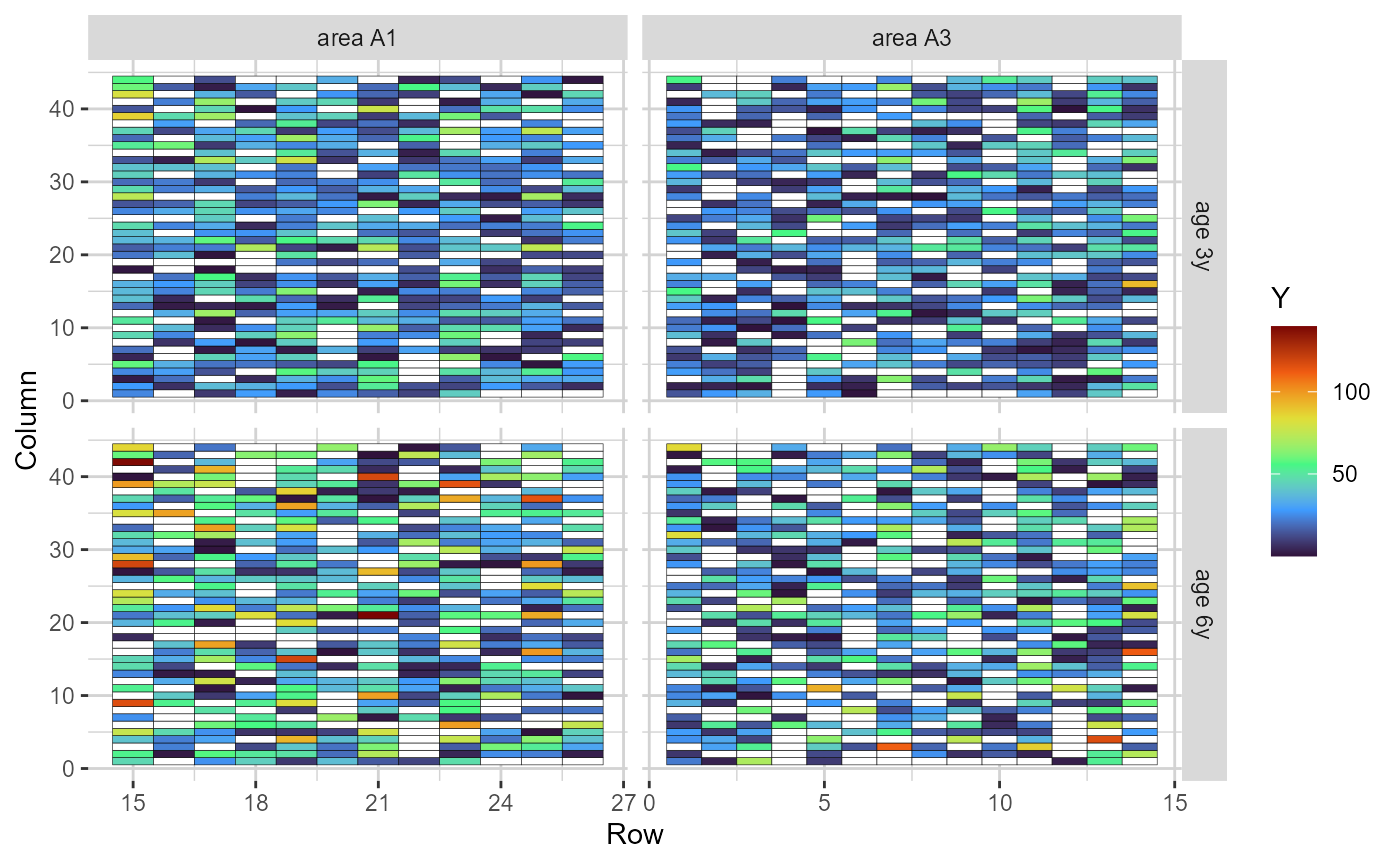
Heatmap representing the grid, in which the cells are filled according to the phenotype value of each plot (blank cells are missing values)
plot(comp_mat, category = "boxplot") + theme(axis.text.x = element_blank())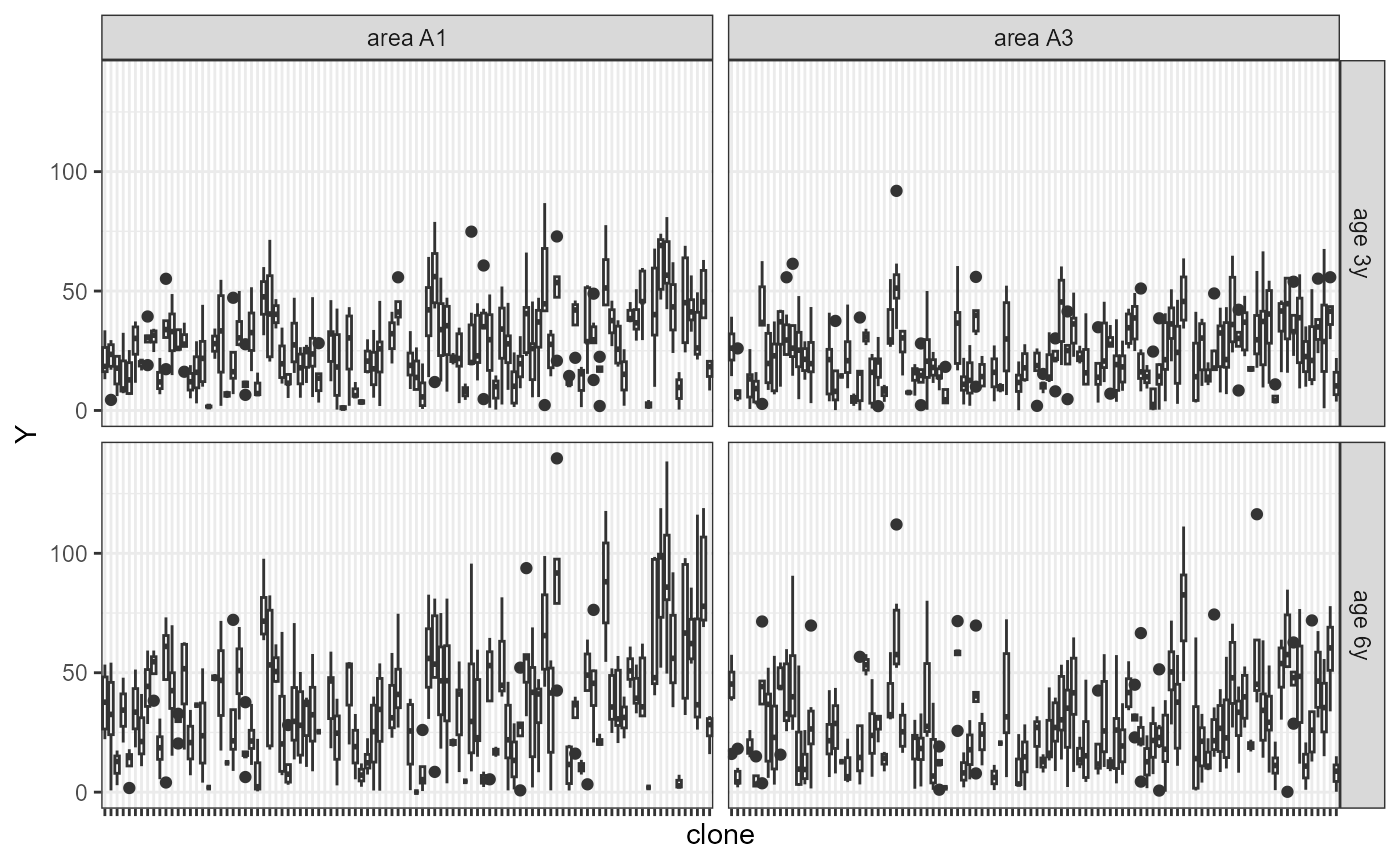
Boxplots depicting the phenotypic performance (y-axis) of each selection candidate (x-axis). The candidates’ names were removed for better visualization
The summary(comprepfor) function returns the number of
phenotypic records, number of selection candidates, number of rows and
columns, and the number of ages and areas.
summary(comp_mat)
#>    MAI clone row col age area
#> 1 2288   100  26  44   2    2
Fitting the model
A general multi-age spatial-genetic competition model can be represented by:
where
is the vector of phenotypic records,
is the vector of fixed effects,
is the vector of direct genetic effects (DGE) nested within ages,
is the vector of indirect genetic effects (IGE) nested within ages,
is the vector of other random effects, and
is the vector of spatially correlated errors.
is the incidence matrix of the fixed effects,
is the DGE incidence matrix,
is the IGE incidence matrix (built using prepfor), and
is the design matrix of other random effects. The dimensions of
are the same as
.
The variance-covariance structure of both
and
is the compound symmetry, meaning that the equation above estimates
their main effects and their interaction with the different ages. The
within-age DGE and IGE can be accessed by adding the main effect to its
corresponding interaction effect from a specific age. The heterogeneous
(per-age) spatially correlated errors are distributed as
,
where
is the spatially correlated residual variance,
and
are the first-order autoregressive correlation matrices in the column
and row directions,
is the Kronecker product, and
is the direct sum. If area is not NULL (like
in the example), heterogeneous residual variances and particular
autocorrelations are also obtained per area. If cor = TRUE
(default, see below), the function will fit a model in which
and
are correlated outcomes of the genotypic effects decomposition.
The function that fits the genetic-competition linear mixed model
uses the average information algorithm implemented in the
asreml package (The VSNi Team
2023). Check the function’s structure using the example
dataset:
model = asr_ma(
  prep.out = comp_mat,
  fixed = MAI ~ age,
  random = ~ block:age,
  lrtest = TRUE,
  spatial = TRUE,
  cor = TRUE
)
prep.out is a comprepfor object.
fixed is a formula, declared just like is usually done for
regular asreml models. random is also a
formula, but this argument should just be altered if other random
effects than the genotypic effects should be considered in the model.
This is because all pre-programmed models already consider DGE and IGE,
as previously described. In our example, we added the block
effect, which was declared in the effs argument of
comprepfor. lrtest defines if hypothesis tests
using likelihood ratio tests should be done. spatial
determines if a regular genetic competition model
(spatial = FALSE) or a spatial-genetic competition model
(spatial = TRUE) should be fitted. Finally,
cor dictates if the function will fit a model considering
the covariance between DGE and IGE (cor = TRUE) or not
(cor = FALSE). asr_ma can receive other
arguments passed on to the asreml function (see
?asreml for more information). The output of the
asr_ma function is an object of classes asreml
and compmod. Since it holds the asreml class,
it is suitable for using with generic functions like plot,
summary, predict, update,
resid and others (see
help("asreml.object")).
Extracting the results
The function to obtain the main results from the compmod
object is called resp, and its structure is exemplified
below using the example dataset:
res = resp(
  prep.out = comp_mat,
  model = model,
  weight.tgv = FALSE,
  sd.class = 1
)
model is the compmod object obtained from
the asr_ma function. weight.tgv receives a
logical value, and determines if the reliability should be used as
weight to compute the total genotypic value (TGV) or not.
sd.class is a weight to multiply the standard deviation of
competition effects when determining the competition classes (defaults
to 1). The resp function returns an object (list) of
classes comresp and comprepfor. This object is
compatible with the generic functions plot,
print and summary. A detailed description of
the results within the list generated by res is provided
below.
Variance components
The data frame with the variance components will yield different
results depending on the model. cor(IGE_DGE), which
represents the correlation between DGE and IGE; DGE and
IGE will always be present in variance component obtained
from compmod objects. The residuals will have different
forms depending if area is NULL or not in the
prepfor function, and if spatial is
TRUE or FALSE in the asr_ma
function.
res$varcomp| component | std.error | z.ratio | bound | %ch | |
|---|---|---|---|---|---|
| block:age | 16.2170 | 5.8367 | 2.7785 | P | 0.0 |
| cor(IGE_DGE) | -0.5830 | 0.1073 | -5.4327 | U | 0.0 |
| DGE | 143.2868 | 23.5141 | 6.0936 | P | 0.0 |
| IGE | 20.6057 | 4.5400 | 4.5387 | P | 0.0 |
| DGE:age | 5.2824 | 4.4706 | 1.1816 | P | 0.2 |
| IGE:age | 0.0000 | NA | NA | B | NA |
| R=area_A1:age_3y | 177.6881 | 14.0806 | 12.6193 | P | 0.0 |
| R=autocor(row):area_A1:age_3y | 0.0784 | 0.0625 | 1.2533 | U | 0.1 |
| R=autocor(col):area_A1:age_3y | -0.1413 | 0.0637 | -2.2199 | U | 0.0 |
| R=area_A3:age_3y | 133.5698 | 10.2324 | 13.0536 | P | 0.0 |
| R=autocor(row):area_A3:age_3y | 0.0315 | 0.0675 | 0.4666 | U | 0.8 |
| R=autocor(col):area_A3:age_3y | 0.0715 | 0.0637 | 1.1225 | U | 0.1 |
| R=area_A1:age_6y | 426.0002 | 34.0643 | 12.5058 | P | 0.0 |
| R=autocor(row):area_A1:age_6y | -0.0313 | 0.0682 | -0.4597 | U | 0.6 |
| R=autocor(col):area_A1:age_6y | -0.1942 | 0.0638 | -3.0427 | U | 0.0 |
| R=area_A3:age_6y | 244.1681 | 19.3033 | 12.6490 | P | 0.0 |
| R=autocor(row):area_A3:age_6y | -0.0365 | 0.0751 | -0.4866 | U | 0.7 |
| R=autocor(col):area_A3:age_6y | 0.0759 | 0.0693 | 1.0943 | U | 0.2 |
Likelihood ratio tests
Available only if lrt = TRUE in the asr_ma
function.
res$lrt| effect | LR-statistic | Pr(Chisq) |
|---|---|---|
| DGE | 109.8212115 | 0.0000000 |
| IGE | 56.7154599 | 0.0000000 |
| DGE:age | 2.0228651 | 0.0774733 |
| IGE:age | -0.0000951 | 0.5000000 |
Heritabilities
Available if cor = TRUE in the function
asr. Contain the DGE heritability and total heritability
Bijma, Muir, and Van Arendonk (2007). The
first is the portion of the total variance that refers to the DGE. The
latter is a ratio between the sum of the total heritable components
against the phenotypic variance, and it is an adjusted estimate of the
heritability that considers the competition effects and the covariance
between DGE and IGE. The expressions for these heritabilities are given
below:
with being the total phenotypic variance.
res$heritability| H2direct | H2total | |
|---|---|---|
| area_A1:age_3y | 0.395 | 0.296 |
| area_A3:age_3y | 0.449 | 0.337 |
| area_A1:age_6y | 0.234 | 0.176 |
| area_A3:age_6y | 0.334 | 0.250 |
Since area is not NULL in our example, and
the model estimates heterogeneous residual variances, the heritabilities
are particularized per area.
BLUPs
When genetic competition effects are statistically significant, the most appropriate selection unit is the TGV, given by:
where
and
are the DGE and IGE of the
candidate, respectively. If weight.tgv = TRUE in the
resp function, the weighted TGV is computed as follows:
with and being the reliabilities of DGE and IGE, respectively.
The comresp object has a data frame containing the DGE
and IGE, their standard errors, the competition class of each genotype
and the TGV. In the multi-age case, there are two lists: one containing
the main effects, and other with the within-ages effects (main +
interaction). If other random effects were declared in the model, there
will be a further data frame with their BLUPs.
head(res$blups$main)| clone | DGE | se.DGE | rel.DGE | IGE | se.IGE | rel.IGE | class | TGV |
|---|---|---|---|---|---|---|---|---|
| C099 | 24.616 | 3.578 | 0.911 | -0.799 | 2.461 | 0.706 | Homeostatic | 22.752 |
| C087 | 13.201 | 4.120 | 0.882 | 2.194 | 2.477 | 0.702 | Homeostatic | 18.316 |
| C083 | 22.710 | 3.620 | 0.909 | -3.442 | 2.510 | 0.694 | Homeostatic | 14.685 |
| C028 | 26.150 | 3.475 | 0.916 | -6.024 | 2.636 | 0.663 | Aggressive | 12.104 |
| C066 | 8.528 | 3.635 | 0.908 | 1.335 | 2.334 | 0.736 | Homeostatic | 11.641 |
| C092 | 28.117 | 3.666 | 0.906 | -7.119 | 2.646 | 0.660 | Aggressive | 11.520 |
head(res$blups$within)| clone | age | DGE | se.DGE | rel.DGE | IGE | se.IGE | rel.IGE | class | TGV |
|---|---|---|---|---|---|---|---|---|---|
| C099 | 6y | 27.029 | 2.172 | 0.967 | -0.799 | 0.001 | 1 | Homeostatic | 25.198 |
| C099 | 3y | 23.506 | 2.159 | 0.967 | -0.799 | 0.001 | 1 | Aggressive | 21.611 |
| C087 | 6y | 14.494 | 2.208 | 0.966 | 2.194 | 0.001 | 1 | Homeostatic | 19.521 |
| C087 | 3y | 12.833 | 2.194 | 0.966 | 2.194 | 0.001 | 1 | Homeostatic | 18.035 |
| C083 | 6y | 23.676 | 2.176 | 0.967 | -3.442 | 0.001 | 1 | Homeostatic | 15.789 |
| C083 | 3y | 22.714 | 2.163 | 0.967 | -3.442 | 0.001 | 1 | Homeostatic | 14.552 |
From this data frame, several information can be extracted. In the
generic function plot, use the argument level
to control if the plot should illustrate information from main effects
(level = "main") or within-ages effects
(level = "within"). If level = "within",
another argument, age, will further define if all ages
should be plotted together (age = "all") or separately
(age = name of a specific age). Check out below.
Competition classes
The higher the IGE, the more aggressive is the genotype. Here, we use a modified version of the classification proposed by Filipe M. Ferreira et al. (2023) to define competition classes:
with being the mean IGE in the population, the IGE of the genotype, the IGE’s standard deviation, and a weight defining the thresholds to declare if a genotype is aggressive, homoeostatic or sensitive.
This classification is illustrated using a density plot, a scatter plot and a heat map representing the field grid. These plots aid in the investigation of the relationship between DGE and IGE, how this dynamics are related to classification, and how aggressive, homoeostatic and sensitive are distributed in the field.
plot(res, category = "class", level = "main")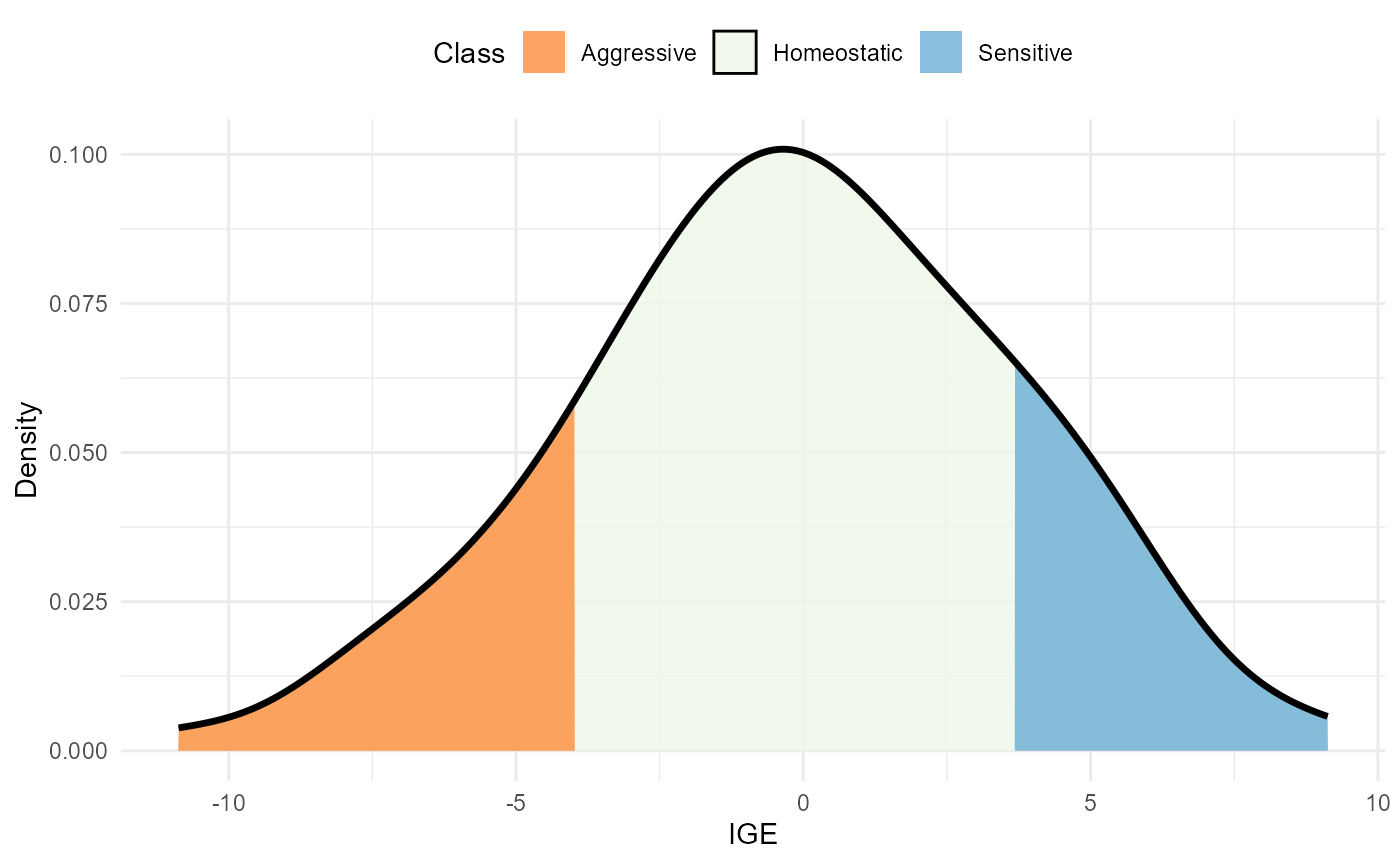
Density of IGE values. The area within the distribution is filled according to the competition class
plot(res, category = "DGEvIGE", level = "within")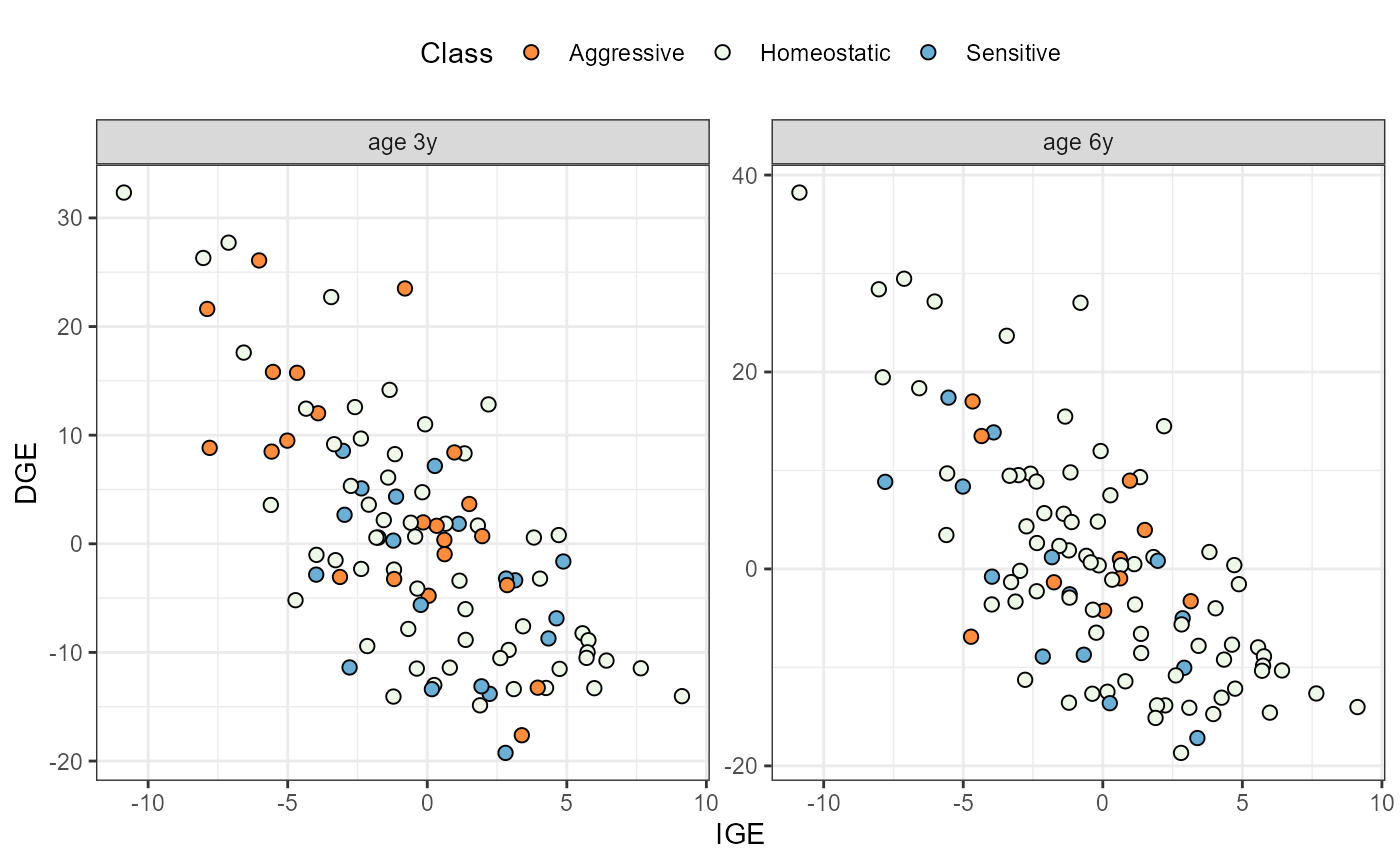
Relationship between IGE (x-axis) and DGE (y-axis). The dots are coloured according to the competition class.
plot(res, category = "grid.class", level = "within", age = "6y")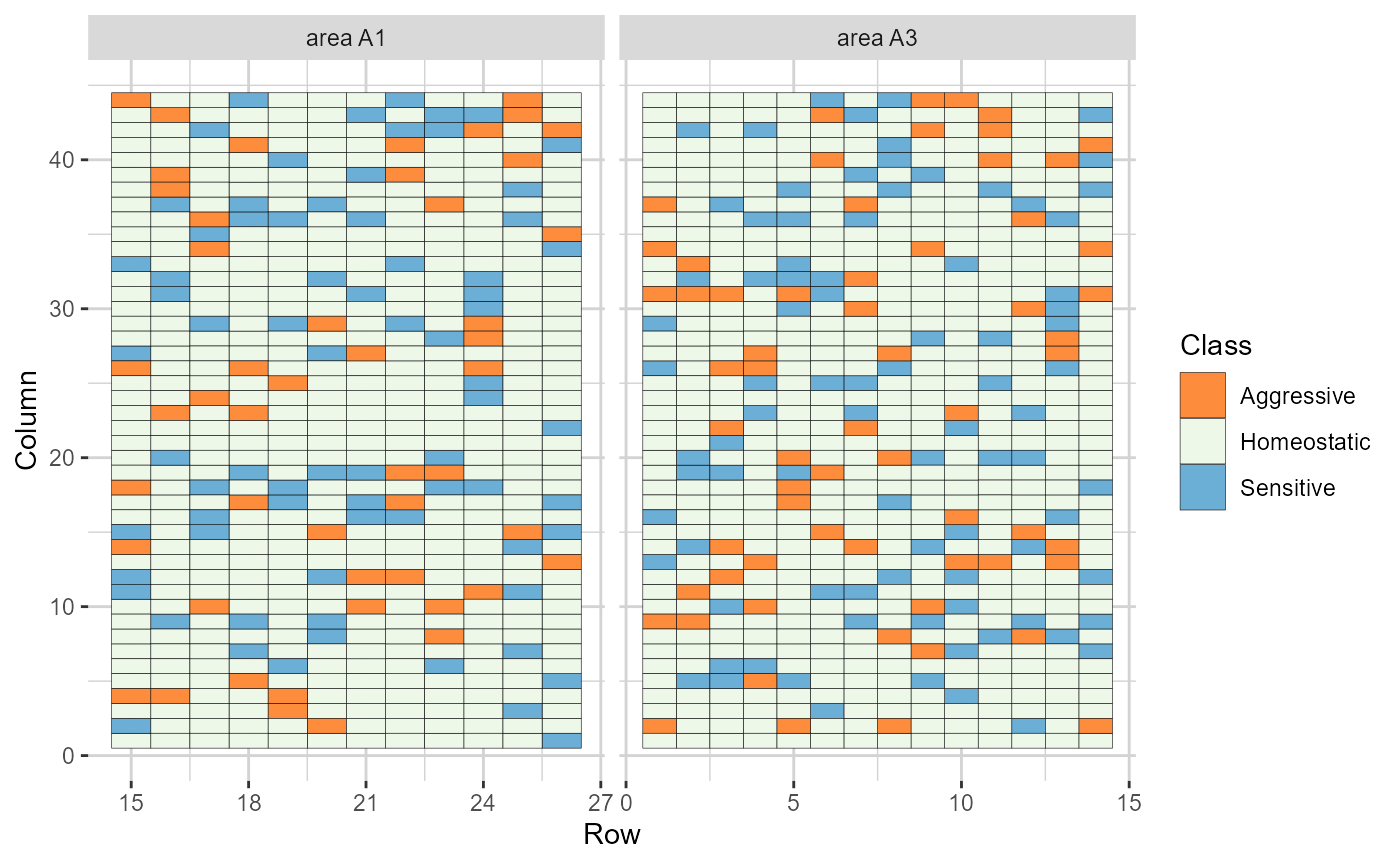
Heatmap representations of the field trial, with cells filled according to the competition class of each genotype
Ranking
Three possible rankings are possible: based on the DGE, the IGE, or the TGV. Note that DGE and IGE have different reliabilities, with DGE’s being usually higher. It is advisable to take this into consideration when making decisions.
plot(res, category = "DGE.IGE", level = "main") +
  theme(axis.text.x = element_text(size = 4, vjust = .5, hjust = 1))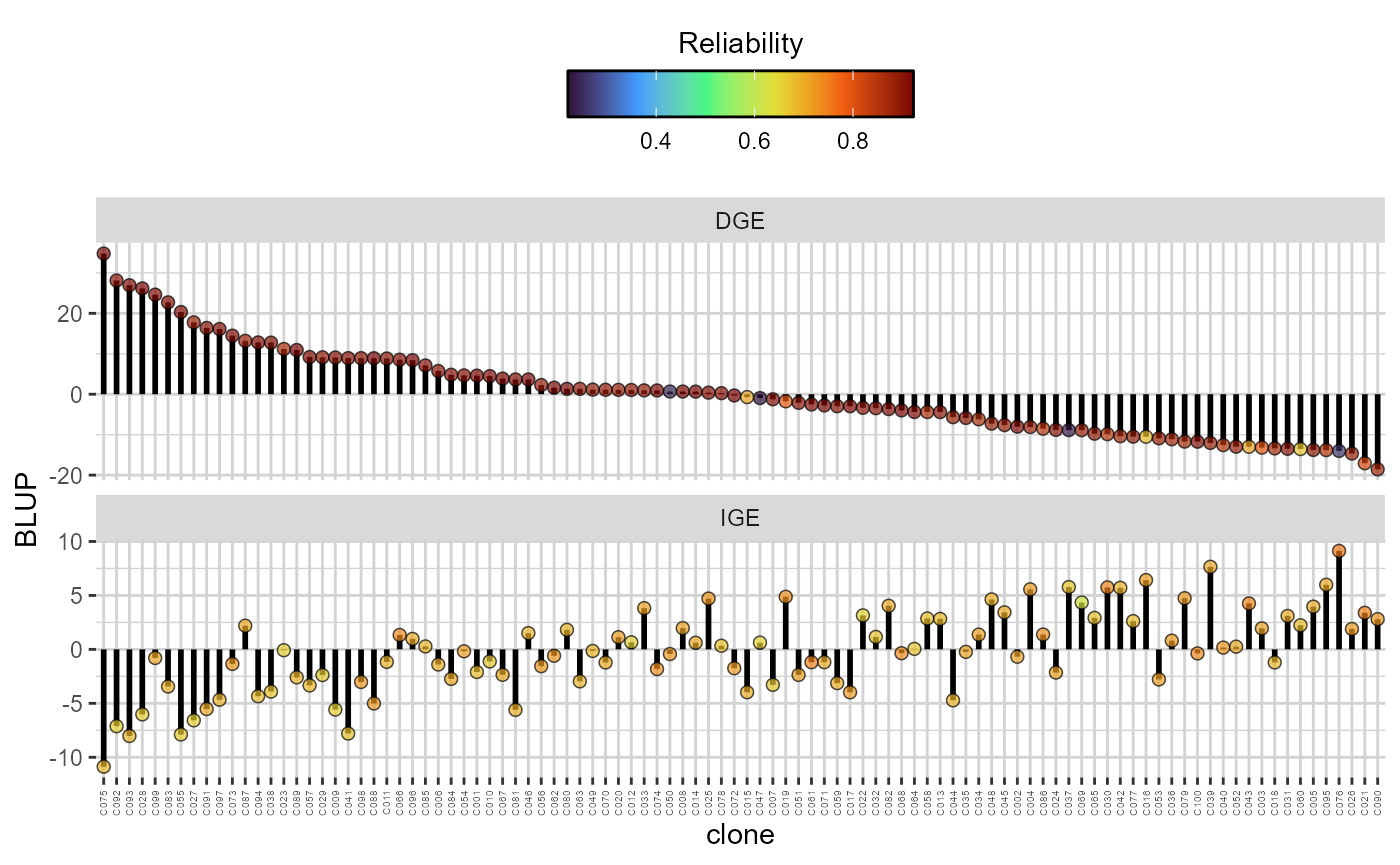
Direct (DGE) and indirect (IGE) genotypic effects ( extit{y}-axis) of each candidate. The plots are in descending order according to the DGE. The colour of the dots reflects the reliability of both the DGE and IGE for each genotype
plot(res, category = "TGV", level = "within", age = "3y") +
  theme(axis.text.x = element_text(size = 4, vjust = .5, hjust = 1))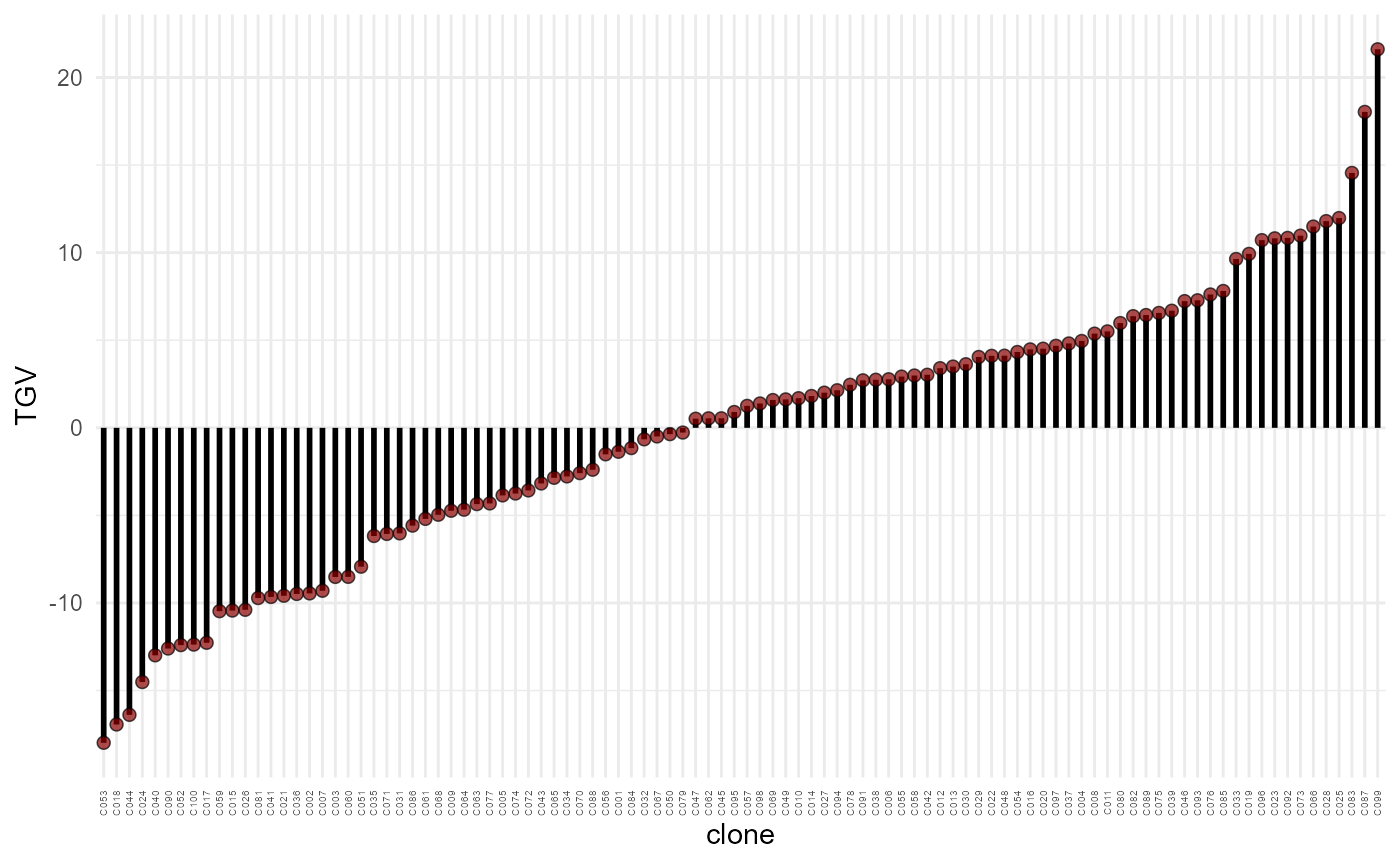
Total genotypic value (TGV) (y-axis) of each candidate (x-axis), in increasing order
The distribution of high-performance and/or competitive candidates is also illustrated.
plot(res, category = "grid.dge", level = "within", age = "all")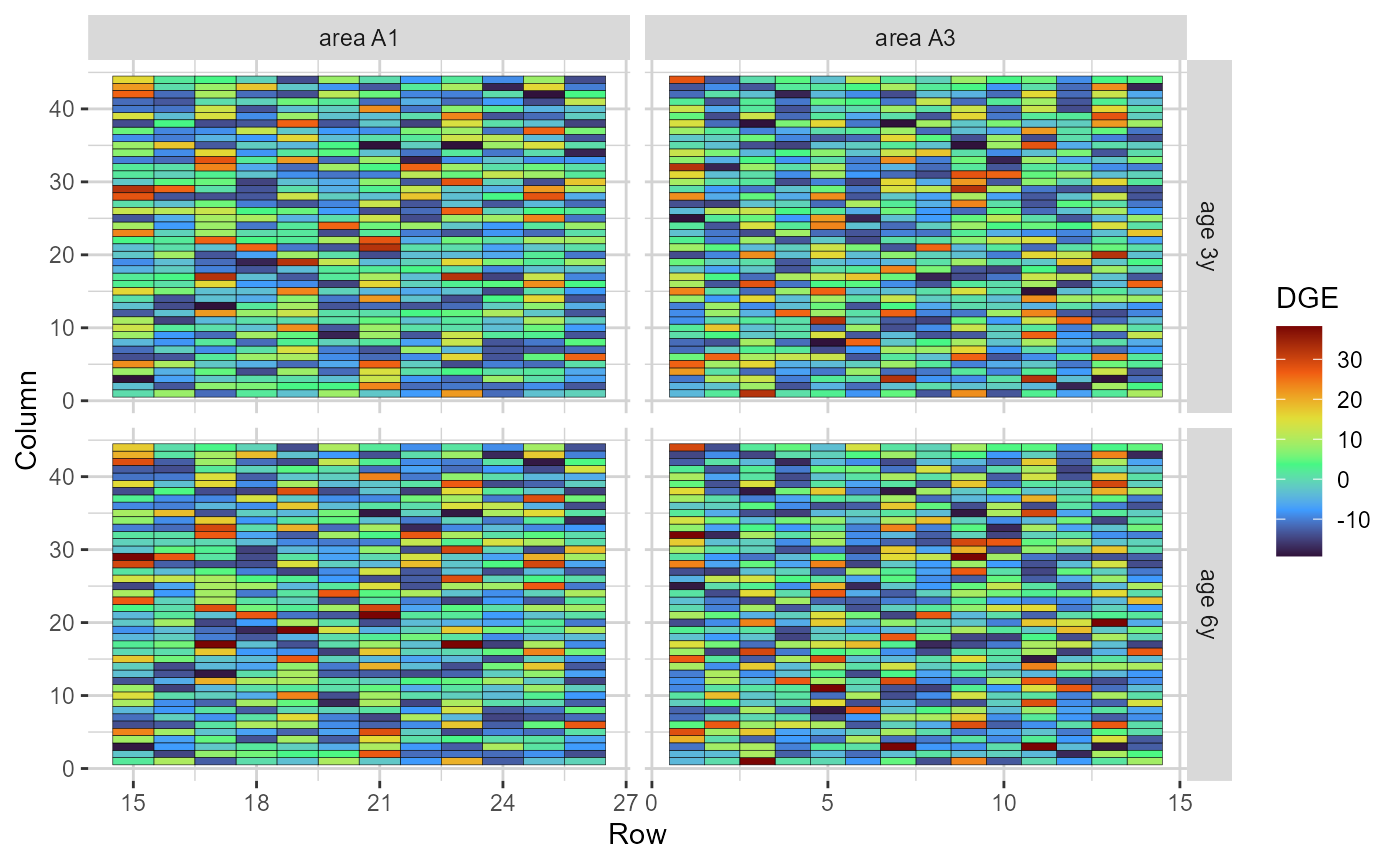
Heatmap representations of the field trial, with cells filled according to the direct genotypic effect (DGE) of each genotype
plot(res, category = "grid.ige", level = "within", age = "3y")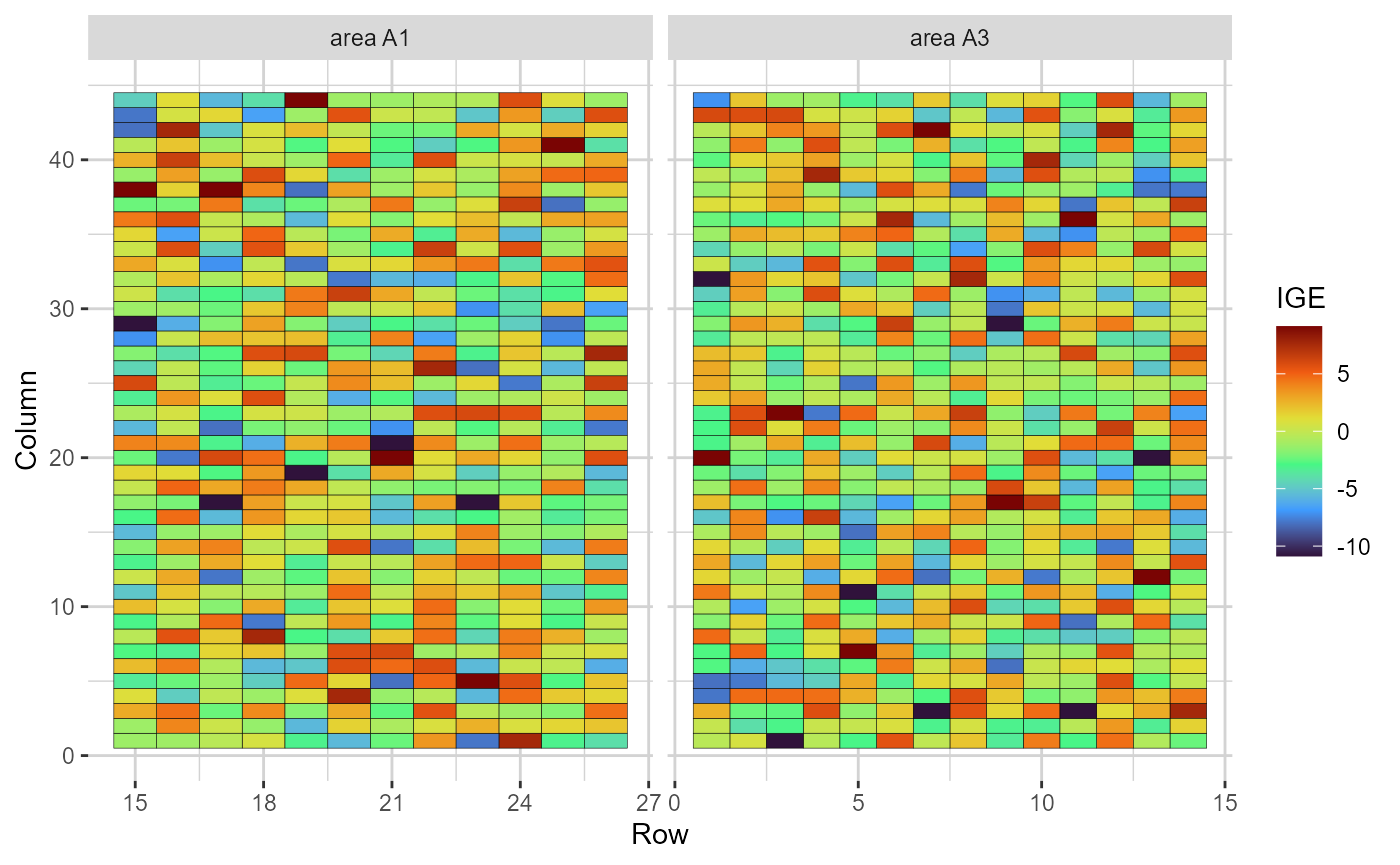
Heatmap representations of the field trial, with cells filled according to the indirect genotypic effect (IGE) of each genotype
Number of different neighbours
The number of different genotypes as neighbours of the candidates can be evaluated by the figure below. In the example dataset, almost all clones neighboured each other, and most of them had homoeostatic neighbours.
plot(res, category = "nneigh", level = "within", age = "all")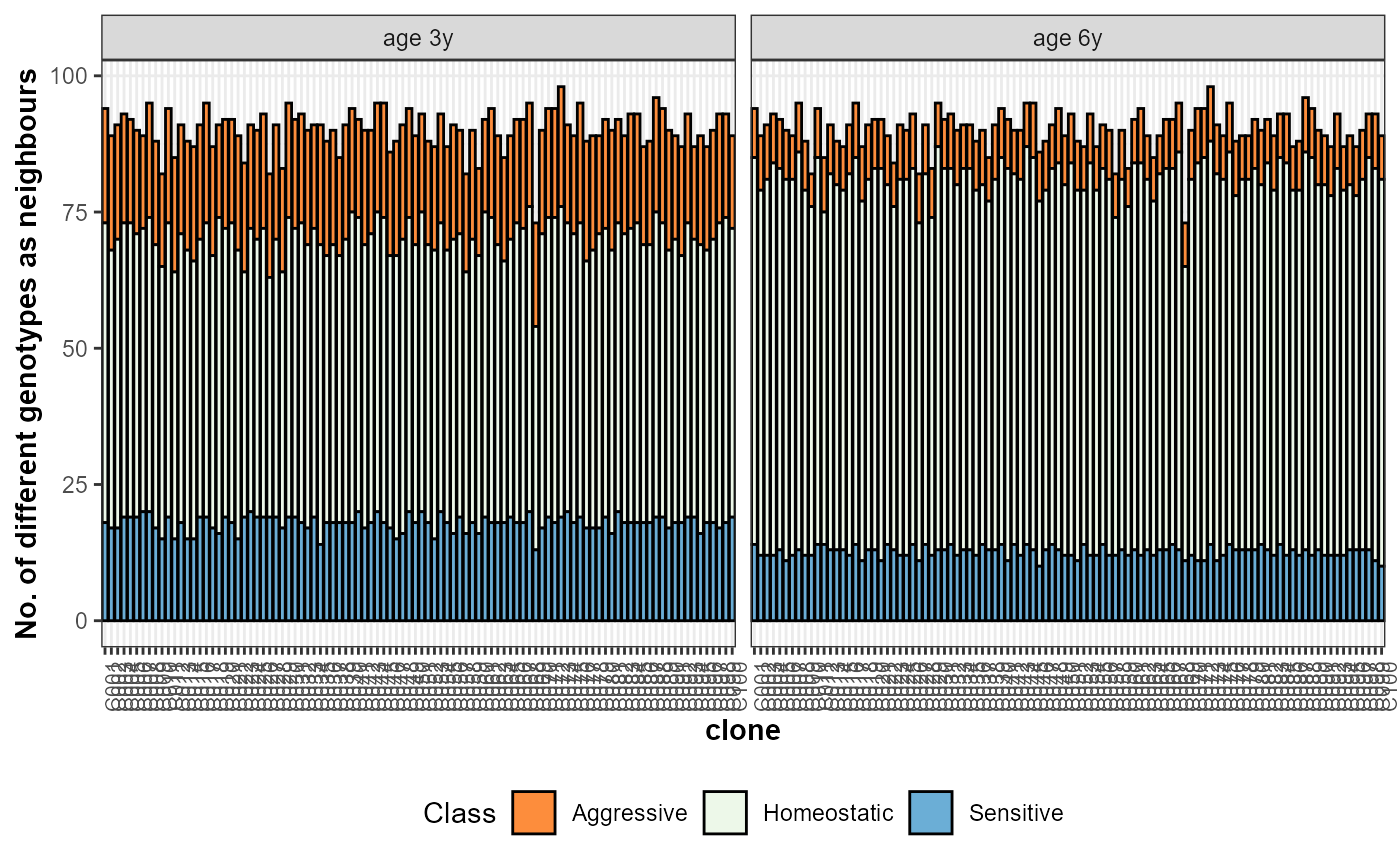
Number of different genotypes as neighbors (total and per competition class) of each selection candidate
Error distribution
The last plot available for objects of class compresp is
a heatmap coloured according to the residual value of each plot. This is
useful to observe possible trends in the field.
plot(res, category = "grid.res", level = "main")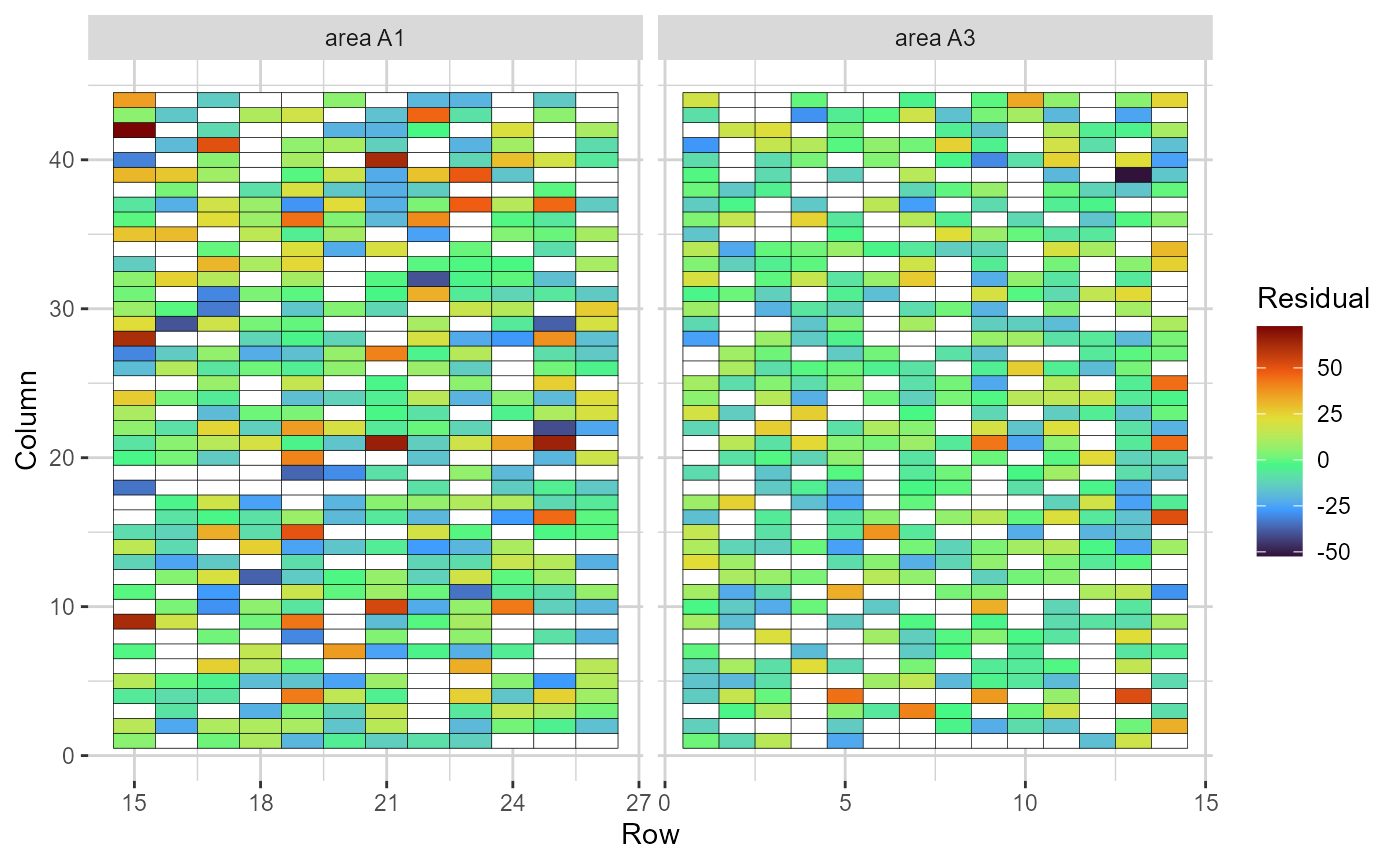
Heatmap representations of the field trial, with cells filled according to the residual value of each plot. Blank cells are missing values